From Scientific Progress to Agricultural Impact

Delivery, Regulatory Science, and Building Confidence in RNA-Based Crop Protection

Image credit: Charles Sturt University
RNA interference (RNAi) has made meaningful progress as a potential new tool for crop protection. Advances in target identification, RNA design, manufacturing, and delivery have expanded the range of pests and diseases that researchers and companies are working to address.
The recent international symposium, The Role of RNAi-based Pesticides in Sustainable Agriculture, supported by the OECD Co-operative Research Programme and hosted by Charles Sturt University in partnership with the University of Queensland and CSIRO, brought together researchers, industry scientists, and regulatory experts to examine the current state of the technology and its path toward practical agricultural use.
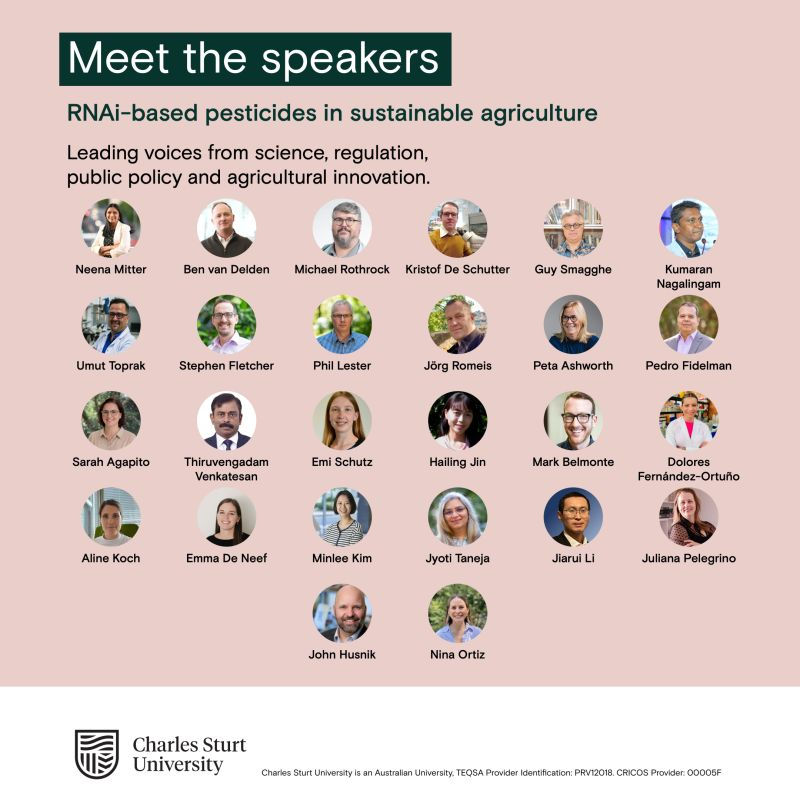
The symposium covered a broad range of topics, from RNA biology and delivery to environmental safety, regulatory science, manufacturing, commercialization, and public acceptance.
Having worked in RNA-based crop protection R&D for many years, I found the discussions particularly valuable for connecting scientific advances with the practical realities of product development and commercialization.
With RNAi-based crop protection products already achieving important regulatory and commercial milestones, the field is moving into an exciting new phase. The focus is increasingly on expanding applications, improving delivery and field performance, and enabling broader adoption.
Several observations stood out to me, particularly the importance of translating scientific advances into reliable agricultural performance, building on regulatory progress, and developing products that deliver practical value to growers.
From RNA Uptake to Functional Delivery
Delivery remains one of the defining challenges in RNA-based crop protection.
The symposium highlighted advances in RNA formulation, plant uptake, transport, and spray-induced gene silencing. Research on cross-kingdom RNA communication, RNA fungicides, and emerging delivery technologies continues to expand our understanding of how externally applied RNA can interact with plants, pathogens, and pests.
These developments are encouraging. But they also reinforce an important distinction.
RNA stability, tissue uptake, transport, detectable gene silencing, biological efficacy are not interchangeable measures of delivery success.
A formulation may protect RNA from degradation without improving its uptake. RNA detected inside plant tissues may not reach the biological compartment where it is needed. Even when RNA reaches a target organism, sufficient uptake and intracellular processing are still required to produce a meaningful biological effect. This is particularly relevant for pests and pathogens that are difficult to reach through conventional foliar applications.
For delivery technologies to become commercially valuable, improvements must ultimately translate into measurable outcomes: lower effective doses, more consistent efficacy, longer protection, or access to targets that existing products cannot adequately control.
The next advances in RNA delivery may therefore depend on better quantitative assays, mechanistic understanding, and the discovery of new formulation materials.
Field Performance Remains the Ultimate Test
Several presentations highlighted the progress being made in translating RNA-based technologies into agricultural applications.
Research on RNA fungicides and novel RNA constructs demonstrated the expanding range of approaches being explored for plant disease management. Industry presentations also illustrated the increasingly systematic process of moving from molecular screening to greenhouse testing and field development. The results were encouraging, but the discussion also highlighted a familiar product-development challenge: achieving sufficient and consistent protection over time.
For agricultural products, biological activity alone is not enough. A successful RNA-based pesticide must perform under variable environmental conditions, including differences in temperature, sunlight, rainfall, crop growth, and pest or disease pressure. Application timing, dose, persistence, and compatibility with existing crop management practices all influence whether laboratory efficacy can become reliable field performance.
Manufacturing economics must also be considered alongside biological performance. Lower-cost RNA production is important, but the commercially relevant measure is ultimately the cost of delivering effective crop protection per hectare.
The real development objective is not simply to produce an active RNA molecule at lower cost, but to deliver reliable protection at an economically viable field dose.
That requires coordinated development of RNA design, formulation, manufacturing, and field-use strategies rather than treating them as separate technical activities.
Regulatory Science Must Evolve Alongside Technology
One of the most valuable aspects of the symposium was the attention given to environmental risk assessment and regulatory science.
RNAi technologies offer the potential for highly targeted biological activity. However, sequence specificity alone does not establish environmental safety.
Assessing potential risks requires understanding not only sequence relationships but also exposure, uptake, RNA processing, and the sensitivity of different organisms. Bioinformatics provides an important screening tool, but computational predictions cannot fully replace experimental evidence.
This becomes particularly important as delivery technologies improve. Formulations designed to increase RNA stability, uptake, or persistence may improve product efficacy. At the same time, they can change exposure patterns and potentially influence interactions with non-target organisms.
Better delivery can improve performance, but it may also change the questions regulators need to ask.
The symposium reinforced the importance of fit-for-purpose, science-based regulatory approaches that consider the characteristics of RNA molecules and their formulations rather than relying exclusively on testing frameworks developed for conventional chemical pesticides.
International regulatory alignment was another recurring theme. Regulatory agencies and researchers across different regions are working to better understand how RNA-based pesticides should be classified, evaluated, and managed.
Greater consistency in scientific principles and data requirements could reduce unnecessary duplication and improve the efficiency of global product development.
But harmonization remains a work in progress. Differences in regulatory frameworks, environmental conditions, and data expectations will continue to influence how companies develop products for different markets.
For developers, the implication is clear: regulatory considerations should be integrated into product design early, particularly when introducing new delivery systems or manufacturing approaches.
Beyond Regulatory Approval: Building Farmer and Public Confidence
Another important theme was the relationship between technological innovation, public acceptance, and agricultural adoption.
These are related, but they are not the same. Regulators need credible evidence to evaluate product quality, efficacy, environmental exposure, and safety. Farmers need confidence that a product will perform consistently, fit their existing management practices, and deliver sufficient economic value. Consumers and the broader public need transparent, understandable information about the technology and its potential benefits and risks.
Regulatory approval is an essential milestone, but it does not automatically create market acceptance.
For growers, the value of a new crop protection technology is not determined by its molecular mechanism. What matters is whether it solves a meaningful agricultural problem.
A product may demonstrate excellent target specificity yet struggle commercially if its protection is too short-lived, its application requirements are impractical, or its cost is difficult to justify.
RNA-based pesticides may offer valuable new options for integrated pest management (IPM), particularly where conventional products face resistance challenges or where additional modes of action are needed.
However, RNAi products are not inherently immune to resistance. Target sequence changes, reduced uptake, or changes in RNAi processing could affect susceptibility, depending on the pest and product. Resistance stewardship and integration with existing pest-management programs need to be considered during development, not only after commercialization.
Public communication is important too. RNA technologies can be difficult to explain, particularly when different products use fundamentally different biological mechanisms and delivery systems. Clear communication about what a product does, how it is evaluated, and what its limitations are will be important for building trust.
Ultimately, successful adoption requires more than demonstrating that a technology works. It requires showing why it matters to farmers and how it can be used responsibly and effectively.
AI and Data-Driven R&D: An Emerging Opportunity

Bioinformatics and computational approaches were another area of discussion, particularly in RNA sequence design and the evaluation of potential off-target effects.
These tools are already important in identifying candidate targets, designing RNA constructs, and supporting safety assessments.
Artificial intelligence and machine learning could extend these capabilities further.
One promising opportunity is to connect molecular design with experimental data generated during biological screening, formulation development, delivery studies, and field evaluation.
Over time, integrated datasets could support more efficient candidate selection, improve experimental prioritization, and help identify relationships between formulation properties, biological activity, and field performance.
However, predicting RNA delivery or field efficacy remains substantially more challenging than analyzing sequence relationships.
Biological barriers, environmental variability, formulation complexity, and species-specific RNAi responses create problems that cannot be solved through computational models alone.
The real opportunity for AI may be less about replacing experiments and more about learning from them more effectively.
For RNAi developers, realizing this potential will require more than sophisticated algorithms. High-quality, reproducible experimental data and the ability to connect insights across molecular design, biological screening, formulation, delivery, and field performance will be equally important. Integrating these capabilities could help accelerate development, guide better decisions, and build a competitive advantage.
Ultimately, AI's value in ag-biotech will be measured by its ability to solve practical problems and improve outcomes, combining computational capabilities with domain expertise, reliable data, and sound scientific judgment.
From Scientific Progress to Agricultural Value
The symposium illustrated how far RNA-based crop protection has progressed, while also highlighting the challenges that remain.
Advances in RNA design, novel constructs, delivery technologies, and manufacturing continue to expand what may be technically possible. At the same time, regulatory science is evolving, and greater attention is being paid to product performance, environmental safety, public confidence, and agricultural adoption.
These developments point to a broader transition. As RNAi technologies advance, the focus is increasingly expanding beyond demonstrating biological activity to delivering consistent field performance, responsible regulatory evaluation, economically viable manufacturing, and practical value for growers.
That transition will require continued innovation across multiple disciplines, along with closer collaboration among researchers, product developers, regulators, agricultural advisers, and farmers.
As RNA technologies continue to advance, I see three priorities shaping the next stage of development:
Advancing delivery and field performance to support a wider range of crops, targets, and agricultural applications.
Building on regulatory progress to establish more consistent, science-based pathways that support innovation and market expansion.
Scaling practical and commercial value through cost-effective manufacturing, integration into farming systems, and broader market adoption.
Progress in these areas will help expand the adoption of RNA technologies and their contribution to sustainable agriculture.
The next chapter of RNA crop protection will build on the scientific and commercial milestones already achieved. Continued success will depend on how effectively we translate innovation into reliable, scalable products that meet regulatory requirements, deliver value to growers, and perform consistently in the field.
----------------------------------------------------------------------------------------
Note: This article reflects my personal interpretation of presentations and discussions at the 2026 RNAi-based Pesticides in Sustainable Agriculture Symposium. The views expressed by individual symposium speakers do not necessarily represent those of the OECD or its member countries.
